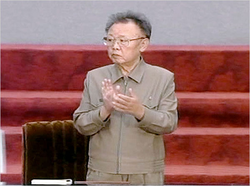
He would have made a great Bobblehead, right?
I said that I did not wish to be imprisoned but Dearest Leader misinterprets the remark, for moments later I am being shackled into leg irons and marched through the mud-strewn paths that connect our villages. Police officers driving ox-drawn carts yell at me to Run Run Run!!!, speed apparently being a measure of good police work, yet it difficult to run when shackled in leg irons (can they not see?) and every hundred meters I tumble to the ground, slowing our progress. The wheels of their carts rut the road, making it yet harder to stagger to my feet to re-commence my Run Run Run!!!
Along the way, villagers gather behind wire fences. Sweat glistens from their sun-browned foreheads. They are good people, my countrymen, subsisting on salted radishes and the hope that their infertile rice paddies may once again provide bountiful harvests. Despite Dearest Leader’s dearest wish, diabolical Yankee imperialists have cursed the fertility of our lands. My arrest is meant to serve as an example to these villagers of what can happen when one blatantly questions the agricultural manure-spread ratios advocated by Dearest Leader, for it is a well-established fact that Dearest Leader is a master agronomist who nightly scours crop yield production charts in search for better ways to feed our people. Firewood has been scarce in recent years, so the good people scythe tall grasses and the spent remains of corn stalks, things that when dried can be burnt for heat.
When I arrive at Penitentiary, Dearest Leader asks the pleasure of my company. Or that is how the request has been interpreted for me by guards, who flail my behind with flashlights in what they say is necessary inspection for lice. Dearest Leader, they say, requires that all admitted in his company be vermin-free. The guards take to the inspection in a particularly vigorous way. With each swat of my behind, they chortle, speculating aloud about my manure yield potential.
“Is he lice-free?” Dearest Leader asks.
“Yes,” the guards respond. “We have beaten him senseless.”
Ha! I think. Though I lay in a brutalized hump from the egregious inspection, I am not senseless.
Dearest Leader pours himself a cup of ginseng tea from an earthenware pot. He is smaller, frailer, than the image on his official portrait, which must have been commissioned many many years ago, but like in the posters and murals that adorn public buildings, he wears a simple brown tunic, his thinning black hair appearing as a bush-like mass atop his head. His hands shake with age. For reasons I cannot understand, he has taken a personal interest in my alleged treachery. Steam rises from the cup when he puts it to his lips.
The Penitentiary lies in the shadow of Mt. Paetku, the sacred mountain where Dearest Leader’s father, Great Leader, first organized The People’s Revolutionary Army in 1939 with the purpose of expelling Japanese occupiers from our land. Though the mountain was covered with snow, azalea bushes spontaneously bloomed in Great Leader’s presence, Nature’s sign that Great Leader’s cause was just. The Japanese armies were successfully routed. Azaleas have become the national flower, a plant treasured throughout the peninsula.
“Do you wish to be a patriot?” Dearest Leader asks.
I am confused. Patriots are those who willingly rat out a brother’s minor offense so they can reap a kilogram of octopus meat. I am brotherless, an only child with no living family members to forsake to achieve patriothood.
“Answer,” the guards say. With a mighty walloping of their flashlights, they deliver one last inspection for lice, and in the woozy moments that follow, I affirm my patriotic desire.
“Good,” Dearest Leader says, which makes me happy for it is impossible to know how many of my countrymen he has sentenced to live out their lives in work camps because of their unwillingness to be patriotic. “You shall be an azalea.”
My heart leaps with joy. If I could bounce to my feet, I would kiss Dearest Leader’s cheeks. To be an azalea is to be of some great national importance, yet I am dumbfounded: somehow the guards have misinterpreted the command. Dearest Leader departs, taking with him the earthenware pot. One of the guards kicks me. The other takes out his flashlight and commences to re-inspect me for lice.
“Let’s corn stalk him,” the guard with the flashlight says.
I fear they have misheard. “I am not a corn stalk, but an azalea!”
But soon they are dragging me to the Penitentiary furnaces, misapprehending Dearest Leader’s will for me to be a national treasure.
Along the way, villagers gather behind wire fences. Sweat glistens from their sun-browned foreheads. They are good people, my countrymen, subsisting on salted radishes and the hope that their infertile rice paddies may once again provide bountiful harvests. Despite Dearest Leader’s dearest wish, diabolical Yankee imperialists have cursed the fertility of our lands. My arrest is meant to serve as an example to these villagers of what can happen when one blatantly questions the agricultural manure-spread ratios advocated by Dearest Leader, for it is a well-established fact that Dearest Leader is a master agronomist who nightly scours crop yield production charts in search for better ways to feed our people. Firewood has been scarce in recent years, so the good people scythe tall grasses and the spent remains of corn stalks, things that when dried can be burnt for heat.
When I arrive at Penitentiary, Dearest Leader asks the pleasure of my company. Or that is how the request has been interpreted for me by guards, who flail my behind with flashlights in what they say is necessary inspection for lice. Dearest Leader, they say, requires that all admitted in his company be vermin-free. The guards take to the inspection in a particularly vigorous way. With each swat of my behind, they chortle, speculating aloud about my manure yield potential.
“Is he lice-free?” Dearest Leader asks.
“Yes,” the guards respond. “We have beaten him senseless.”
Ha! I think. Though I lay in a brutalized hump from the egregious inspection, I am not senseless.
Dearest Leader pours himself a cup of ginseng tea from an earthenware pot. He is smaller, frailer, than the image on his official portrait, which must have been commissioned many many years ago, but like in the posters and murals that adorn public buildings, he wears a simple brown tunic, his thinning black hair appearing as a bush-like mass atop his head. His hands shake with age. For reasons I cannot understand, he has taken a personal interest in my alleged treachery. Steam rises from the cup when he puts it to his lips.
The Penitentiary lies in the shadow of Mt. Paetku, the sacred mountain where Dearest Leader’s father, Great Leader, first organized The People’s Revolutionary Army in 1939 with the purpose of expelling Japanese occupiers from our land. Though the mountain was covered with snow, azalea bushes spontaneously bloomed in Great Leader’s presence, Nature’s sign that Great Leader’s cause was just. The Japanese armies were successfully routed. Azaleas have become the national flower, a plant treasured throughout the peninsula.
“Do you wish to be a patriot?” Dearest Leader asks.
I am confused. Patriots are those who willingly rat out a brother’s minor offense so they can reap a kilogram of octopus meat. I am brotherless, an only child with no living family members to forsake to achieve patriothood.
“Answer,” the guards say. With a mighty walloping of their flashlights, they deliver one last inspection for lice, and in the woozy moments that follow, I affirm my patriotic desire.
“Good,” Dearest Leader says, which makes me happy for it is impossible to know how many of my countrymen he has sentenced to live out their lives in work camps because of their unwillingness to be patriotic. “You shall be an azalea.”
My heart leaps with joy. If I could bounce to my feet, I would kiss Dearest Leader’s cheeks. To be an azalea is to be of some great national importance, yet I am dumbfounded: somehow the guards have misinterpreted the command. Dearest Leader departs, taking with him the earthenware pot. One of the guards kicks me. The other takes out his flashlight and commences to re-inspect me for lice.
“Let’s corn stalk him,” the guard with the flashlight says.
I fear they have misheard. “I am not a corn stalk, but an azalea!”
But soon they are dragging me to the Penitentiary furnaces, misapprehending Dearest Leader’s will for me to be a national treasure.
 RSS Feed
